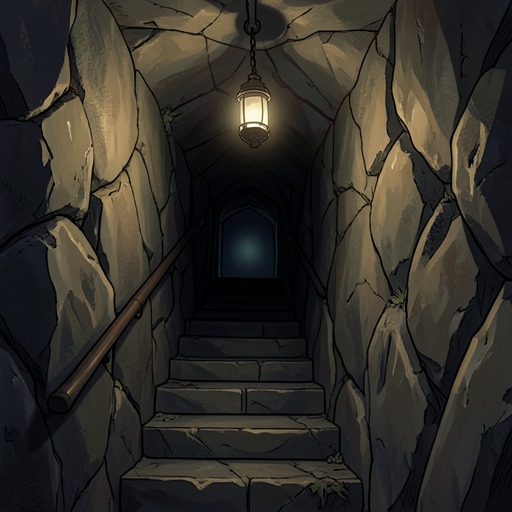
Winding Staircase
The Lost SymbolThe Winding Staircase is a Masonic symbol for the mind’s ascent toward divine truth, and a crucial distinction between allegory and literal reading in the novel. Its apparent promise of a secret passage beneath the House of the Temple drives Mal’akh’s demands, but Peter Solomon explains that the Masonic staircase is symbolic; the story’s actual descending staircase is in the Washington Monument, where it leads toward the Bible concealed in the monument’s cornerstone.
Masonic Symbol and Meaning
The Winding Staircase appears on second-degree Masonic tracing boards as an image of the initiate’s intellectual climb toward divine truth. Its steps represent virtues of the mind, and its upward course figures a pathway from earthly existence toward the spiritual realm. The novel connects the emblem to Jacob’s ladder, another image of ascent between earth and heaven.
This symbolism also joins the staircase to the human body. Peter explains that Masonic teaching treats the spine as a staircase through which energy ascends and descends, connecting the physical body with the mind. The spine’s thirty-three vertebrae echo the thirty-three degrees of Masonry, while the sacrum at its base literally means sacred bone. In this account, the body is a temple and the staircase is an image of the relationship between bodily life and spiritual possibility.
Mal’akh’s Literal Reading
At the House of the Temple, Mal’akh insists that the Masonic legend describes a real staircase descending beneath the building to the Lost Word. He points to the temple’s pyramid-shaped ceiling and the altar, and argues that the entrance must lie somewhere below them. Peter denies that such a passage exists, but Mal’akh produces the decoded symbols from the Masonic Pyramid: grouped into an image, they appear to show a staircase beneath a pyramid. The image strengthens Mal’akh’s belief that the legendary route is physically present.
Peter recognizes the image’s significance but understands the staircase as allegory, not architecture. With Katherine’s life at stake, he pretends to confirm Mal’akh’s theory and promises to lead him to the passage if he first sends help to her. Mal’akh rejects the deception. He then reveals a staircase tattoo running up his back, its steps aligned with his vertebrae. The tattoo turns the emblem into a literal feature of his own body, while underscoring the gap between Peter’s symbolic explanation and Mal’akh’s insistence on finding a physical route.
The Pyramid’s Staircase Image
Later, Robert Langdon reads the pyramid’s grid as a picture of heaven and earth. In his interpretation, Heredom, meaning the Holy House, occupies the upper part of the image; below it, the pyramid rises from the earthly realm toward heaven. The staircase beneath the pyramid represents the Masonic Winding Staircase, climbing from earthly darkness toward light. Langdon reads the larger image as an allegory in which philosophies and religions converge toward a shared human understanding, symbolized by the circumpunct above the capstone.
Peter argues that the grid also has a more concrete function: he believes it maps the location of the Lost Word. The image therefore sustains two readings at once. Its staircase can express a spiritual ascent in Masonic symbolism, while Peter’s claim that the grid guides the worthy to a hidden location invites a geographical interpretation. That ambiguity helps explain why Mal’akh mistakes the symbol for directions to a secret chamber beneath the House of the Temple.
The Washington Monument Staircase
The novel eventually places a real winding staircase in the Washington Monument. It consists of 896 stone steps spiraling around an open elevator shaft, and Robert Langdon and Peter descend it together. Peter tells Langdon that the hollow cornerstone contains a copy of the Bible, placed there by the nation’s founders; it waits in darkness at the foot of the staircase.
This physical descent differs from the imaginary passage Mal’akh seeks beneath the House of the Temple. The Masonic emblem points toward intellectual and spiritual ascent, while the Monument’s steps lead downward to a concealed book. By linking these meanings, the novel turns the staircase into both an interpretive key and a route to the Lost Word: what Mal’akh seeks as a hidden architectural secret is ultimately associated with wisdom preserved in scripture.